
Choose what sounds like your family
12 places to find your next story
You do not need all twelve in every edition. Pick a few that fit the news you actually have, and let different people take the lead each time.
The big family news
A wedding, a new baby, a move or a retirement can lead the edition. Collect the names, what happened and when, then ask the people involved which photograph and details they want to share. Give a big occasion more room; the rest of the paper can hold the everyday news.
Try asking: What happened, who was there, and which moment would you most like to remember?
Small wins worth a headline
A first driving lesson, finishing a tricky book or finally putting up the shelf all count. A specific little achievement tells the family more than a general “we’re doing well”. Add a photo of the finished thing if there is one.
Try asking: What have you managed this quarter that you were pleased about?
A postcard from your everyday life
Show relatives what an ordinary week looks like: the walk before work, the view from the kitchen or the café you keep returning to. These details are especially useful when different households live far apart.
Try asking: What would we see if we spent a normal Tuesday with you?
The pets column
A stolen cushion, a new favourite toy or a muddy walk can make a short, cheerful item. Send a photograph and explain what actually happened. A caption can do the job when the picture tells most of the story.
Try asking: What has the pet done recently that the rest of the family would recognise immediately?
Something from the kitchen
Share the dish everyone asked for again, a baking attempt or a recipe passed down through the family. Include quantities and the method if you want someone else to cook it. Credit the person who shared it, and use your own wording or a link for recipes from books and websites.
Try asking: What have you cooked lately, and is there a story behind the recipe?
A trip, told through one moment
Choose a memorable part of a holiday or day out rather than listing every stop. A missed turn, a view or a particularly good lunch gives the story a clear focus. Add where it happened and a caption for the photograph.
Try asking: Which moment would you tell us about first if we met for lunch?
The garden, hobby or ongoing project
Tomatoes on a balcony, a half-finished jumper, a running route or a restored chair all make good returning columns. Include what changed since the last edition. An unfinished project is still a story; a progress photograph makes it easy to follow.
Try asking: What are you making, growing, practising or slowly getting better at?
An old photograph with its story
Ask someone to choose one photograph and identify the people, place and occasion. Find out what happened just before or after it was taken. If nobody remembers the year, say so instead of choosing a date that sounds right.
Try asking: Who is in this picture, and what would we never guess just by looking at it?
A recommendation from the family
A book, film, recipe, walk or local place can fill a useful little corner. Ask for one sentence about why they liked it and who else might enjoy it. A personal reason is more interesting than a star rating.
Try asking: What have you enjoyed enough to recommend to one of us, and why?
The words you want to keep
An exact remark can bring a piece to life: a grandparent’s explanation, a child’s question shared by their parent, or a friend’s verdict on a new hobby. Write down the wording and who said it. If you only remember the gist, describe it without quotation marks.
Try asking: Did someone say something recently that you wish you had written down?
Family notices and dates
Collect birthdays, anniversaries, planned visits and events for the next quarter. Check names, dates and whether plans are confirmed before adding them. Keep private addresses and travel details out unless the people involved want them included.
Try asking: What should the family put in the diary before the next edition?
A shared question for everyone
Ask every household the same simple question and put the answers together. It creates a little cross-family feature without asking anyone to write an essay. Use a different question next quarter so it becomes a familiar tradition.
Try asking: What is one thing that has made you smile in the last three months?
From an update to a headline
A small story is still a story
You do not need a wedding or a round-the-world trip. A few specific facts and someone’s own words are enough for a short newspaper item.
Fictional worked example: Robin and this update are invented to demonstrate the process.
The update Robin sends
“I grew six tomatoes on the balcony in August. The first one was too sour. I’ve already bought seeds for next year.”
The newspaper item
Six tomatoes, and plans for next year
Robin harvested six tomatoes on the balcony in August. “The first one was too sour,” Robin said. Seeds for next year have already been bought.
The item keeps the supplied facts and Robin’s words. It does not invent a celebration, a family reaction or a bumper harvest. A photograph of the tomatoes would give this small story a place on the page.
Make it easy to reply
A message you can send to the family
Copy this into your family chat and add your deadline. Keep the request small enough for someone to answer while the kettle boils.
Using The Relative? Once you have started your newspaper, invite each adult through the site so they can add their own updates and photographs.
Give each story its place
How to put an edition together
Choose the lead story
Give the most significant news the largest space: perhaps a wedding, a milestone birthday or a move. In a quiet quarter, a strong photograph and an everyday story can lead instead.
Mix long and short pieces
Let a big event breathe, then use shorter updates, a recipe or a pets item around it. Do not stretch someone’s one-line update into a long article just to fill space.
Keep pictures beside their stories
Choose images that help explain the news. Add who, where and what to captions, and check that the people pictured are happy to be included.
Check the details before sharing
Confirm spellings, dates, names and quotations. Give people a chance to correct their information, and leave uncertain details out until someone can confirm them.
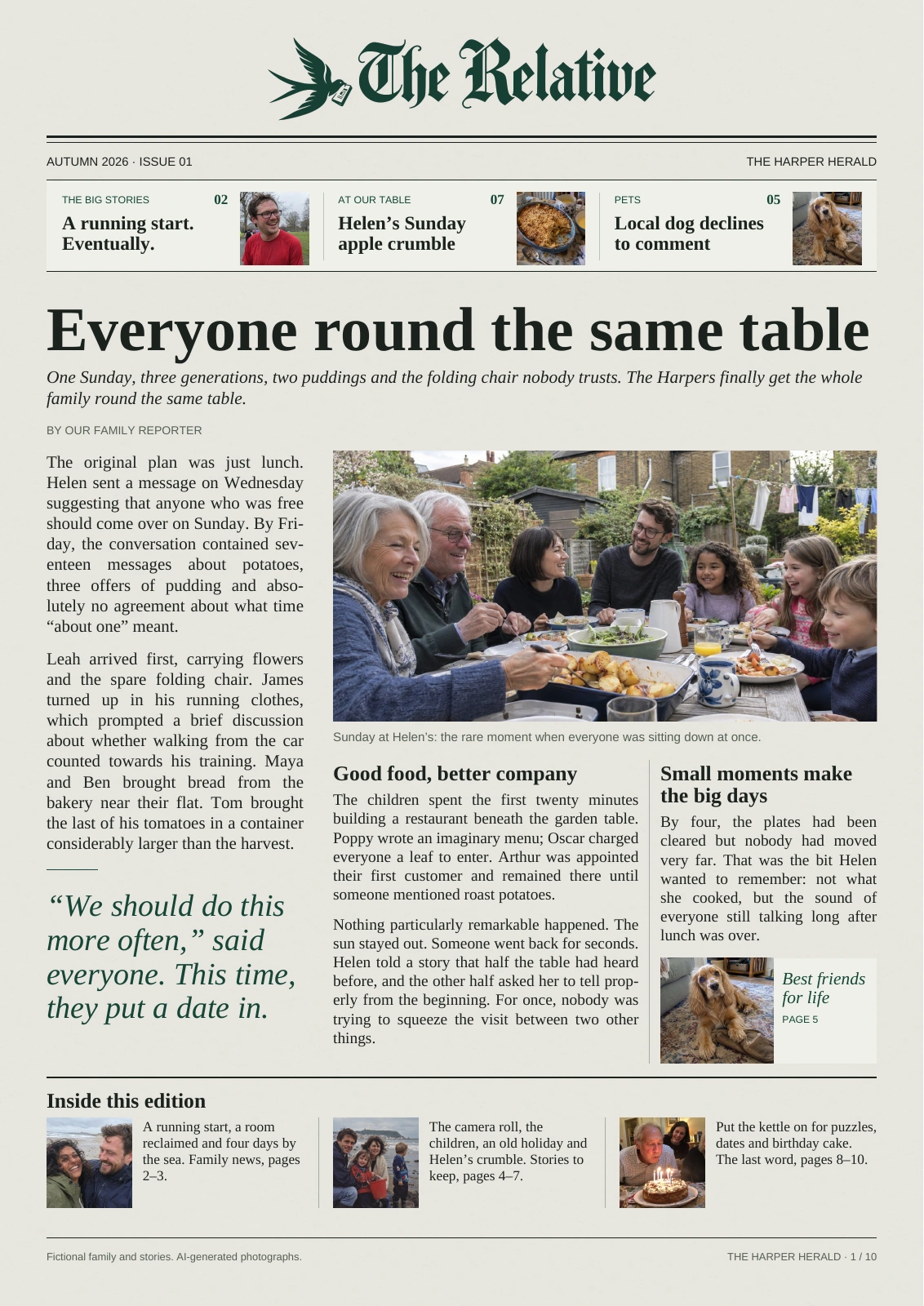
Look through the fictional Harper Herald sample to see articles, photographs, a recipe and puzzles arranged as a family newspaper.